
DiATOME the histo knife for light microscopy
Applications:
High quality diamonds guarantee perfect sections and a durable cutting edge
Easy wetting cutting edge
Optimised serial sectioning
Large boat for easy pick-up
Knife type | Knife angle | Size | Thickness | Boat type | Application |
|---|---|---|---|---|---|
histo | 45° | 4.0mm | 0.2-2mm | histo boat | Sectioning biological and industrial materials specimens for optical microscopy |
histo Jumbo | 45° | 6.0mm | 0.2-2 | Jumbo boat | Large boat for serial sectioning |
histo cryo | 45° | 4.0mm | 0.2-2 | histo holder | Sectioning biological and materials specimens for optical microscopy |
histo cryo | 45° | 4.0mm | 0.2-2 | Small histo boat | Wet sectioning of polymers (with DMSO/water mixture) |
Histo knives
The knife is designed for the sectioning of hard and soft biological and industrial materials, non-embedded or embedded in methacrylate or epoxy resins.
The Histo knife may be used on all ultramicrotomes and microtomes with a retraction of the specimen in the return phase.
For the production of our Histo knives we use natural diamonds of highest quality. They guarantee the best quality and durability of the cutting edges.
Some of the advantages of our Histo diamond knife compared with glass knives:
Perfect sections, free of scores or compression
Serial sections without knife change
Thinner sections
Extreme durability of the cutting edge
No knife making procedure
Lifetime guarantee
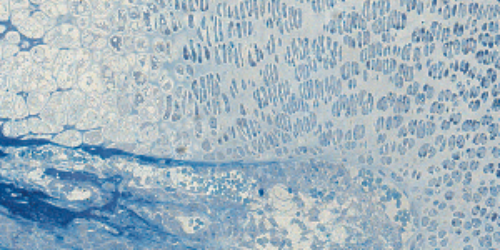 Nondecalcifi ed rat bone. Scale: 35 mm = 100 μm. Daniel Studer, Anatomisches Institut, Bern.
Histo Jumbo knives
For 3D reconstruction it is imperative not to lose a single section (Ref. Blumer).
The large Jumbo boat as well as the adhesive (Pattex compact by Henkel) applied to the side of the sample block increase the distinct advantages of our histo knives.
Features:
Easy production of section ribbons (0.5-2µm)
No section loss
No folding
The same orientation of all sections
Easy collection of section ribbons
Multiple ribbons on one glass slide
Perfect for immuno-histo-chemistry
 Eye of A. peroni: photographic sequence of some semithin sections of a complete serie through the eye.
L = lens; RE = retina.
Michael J. F. Blumer, Institut für Zoologie, Universität Wien.
Reprinted from: Ribbons of semithin sections: an advanced method with a new type of diamond knife. Journal of Neuroscience Methods 120, pp. 11 – 16, 2002, with permission from Elsevier.
Histo Cryo knives
histo cryo knives are delivered with a boat for wet sectioning using a DMSO/water mixture or in triangular holders for dry sectioning, made of a special copper/nickel alloy, which guarantees the best heat/cold transmission.
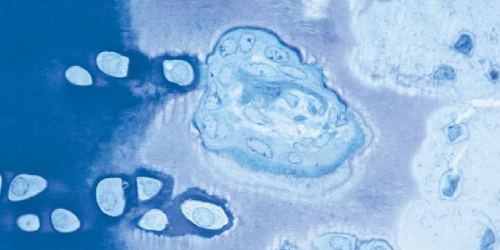 E. B. Hunziker, M. E. Müller, Institute for Biomechanics, University of Bern. Rabbit joint, calcified cartilage/bone. X760
References:
O.L. Reymond: The «semi» diamond knife: a substitute for glass or conventional diamond knives in the ultramicrotomy of thin and semi-thin sections. Bas. Appl. Histochem. 30, pp. 487-494, 1986.
M.J.F. Blumer, P. Gahleitner, T. Narzt, C. Handl, B. Ruthensteiner: Strips of semi-thin sections: an advanced method with a new type of diamond knife. Journal of Neuroscience Methods 120,pp. 11-16, 2002. Contact adress M.J.F. Blumer: michael.blumer@uibk.ac.at
M.J.F. Blumer: Development of a unique eye: photoreceptors of the pelagic predator Atlanta peroni (Gastropoda, Heteropoda). Zoomorphology 119, pp. 81-91, 1996.